
Martingale Collars: How They Work, Fit & Which to Choose
A martingale collar is a limited-slip dog collar that tightens under leash tension and loosens when that tension is released. Its smaller loop limits how far the collar can tighten, while a properly fitted main strap helps prevent the collar from slipping over the dog’s head.
Martingales are useful for more than preventing back-out. They are also an option for supervised everyday walks and training. Choosing one involves understanding its fit, materials and mechanism, along with your dog’s needs.
At dogIDs, we’ve worked with different martingale designs over the years. Details that seem small on a workbench can make a noticeable difference in use: how freely the loop moves, how promptly it releases tension and how the collar fits.
How Does a Martingale Collar Work?
A typical martingale has two main parts: the strap that encircles the dog’s neck and a smaller loop connecting the strap’s ends. The leash attaches to the designated ring on that smaller loop.
When leash tension increases, the smaller loop draws the ends of the main strap closer together, reducing the collar’s circumference. When tension is released, the mechanism can move back toward its relaxed position.
Unlike a traditional slip collar, a martingale has a limit to how far its mechanism can travel. That limit is an important feature, but it does not make the collar harmless regardless of fit or handling.
The loop limits additional tightening. The overall collar size determines how tight the collar can become.
A martingale that is too small can still exert excessive neck pressure. Correct sizing and thoughtful handling matter just as much as the limited-slip design.
Benefits of a Martingale Collar
A More Secure Fit
A properly fitted martingale can help reduce the risk of a dog backing out of a collar. This can be useful when a dog becomes startled, stops suddenly or tries to reverse away from something.
No collar guarantees that a dog cannot escape. Check the adjustment, hardware and condition regularly, and choose equipment appropriate for your dog and the setting.
An Option for Walking and Training
Martingales can be practical for supervised walks and training sessions, including for dogs that have never slipped out of a flat collar.
The collar provides a physical connection through the leash. Teaching your dog to walk comfortably with you still requires practice, rewards and manageable distractions. Tightening alone does not teach loose-leash walking.
Different Materials and Personalization Options
Martingales come in different strap materials, widths, closures and identification styles. Depending on the design, you can choose embroidery, an engraved buckle or a nameplate to display contact information.
Personalization is useful, but it does not change the need to remove a martingale when your dog is unattended. Keep microchip registration current as another form of identification.
Which Dogs Can Benefit From a Martingale?
Martingales have long been popular for dogs whose heads are narrow relative to their necks. Greyhounds, whippets and salukis are familiar examples because a conventional collar may slip over their heads.
Their usefulness extends beyond those breeds. Mixed-breed dogs and dogs of other shapes may also benefit from a properly fitted martingale for supervised walking and training.
Breed alone does not determine the right collar. Consider your dog’s measurements, comfort, health, behavior and the activity you have planned.
A large or powerful dog does not automatically need a martingale, and a martingale is not an automatic solution for lunging or persistent pulling. Some dogs need different equipment and a training plan developed with professional guidance.
Understanding the Built-In Tightening Limit
In the martingale designs we describe here, the smaller loop is constructed with a set amount of travel. Once that travel is used, the mechanism cannot continue drawing the main strap tighter.
The main strap may be adjustable or fixed in size. A sizing slider or belt-style buckle changes the main collar’s circumference. A quick-release buckle changes how the collar opens and closes. These features serve a different purpose from the smaller loop’s tightening limit.
This is why it is important to check the collar in both its relaxed and tightened positions. A comfortable relaxed fit alone does not establish that the tightened fit is appropriate.
Chain Versus Fabric Martingale Collars
Chain and fabric martingales perform the same basic limited-slip function. Their materials and construction affect how they feel, move and respond.
| Feature | Chain Loop | Fabric or Nylon Loop |
|---|---|---|
| Sliding mechanism | A chain assembly moves through metal rings. | A webbing loop moves through metal hardware. |
| Movement | In our experience, a well-designed chain assembly generally moves with less resistance. | Resistance varies with the webbing, hardware, construction and condition. |
| Strap choices | Available with different main strap materials, including waterproof options. | Commonly paired with nylon or fabric main straps. |
| What to check | Fit, chain and ring condition, attachment points and free movement. | Fit, stitching, webbing wear, hardware and free movement. |
How dogIDs Chain Assemblies Are Constructed
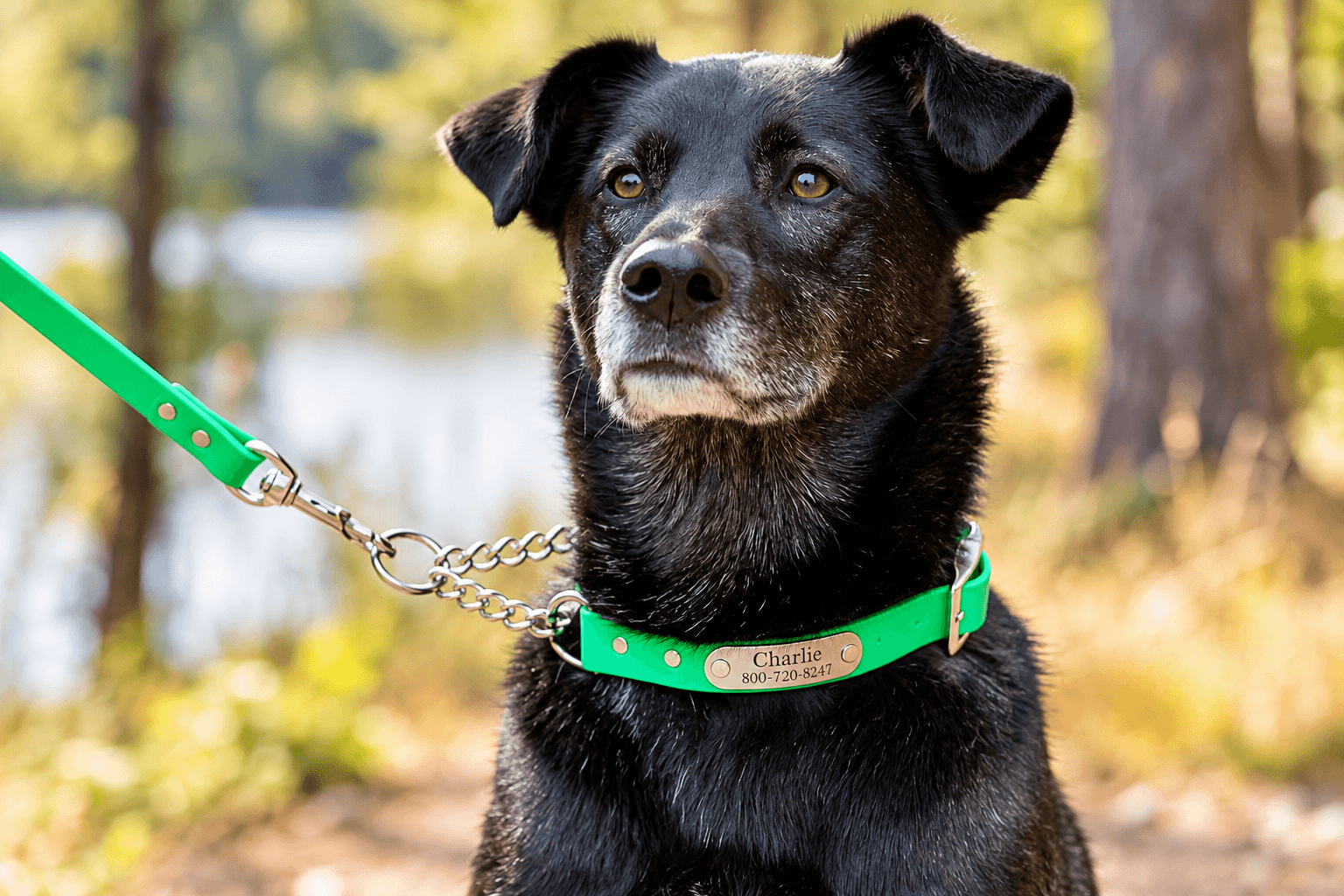
Our chain martingales use two moving metal rings that connect the chain assembly to the main collar strap. A third ring integrated into the chain assembly provides the leash attachment point.
We use two chain assembly sizes to accommodate different strap widths. Our smaller assembly uses 1-inch strap-attachment rings for 5/8-inch and 3/4-inch collars. The larger assembly uses 1.25-inch rings for 1-inch collars.
Both assemblies provide approximately 2.5 to 2.75 inches of chain travel. These are details of the dogIDs assemblies described here, rather than specifications for every martingale collar.
How Fabric Martingales Are Constructed
A fabric martingale typically uses a smaller loop of nylon webbing that passes through hardware attached to the main collar. A leash-attachment D-ring is sewn into that smaller loop.
As tension changes, the webbing moves through the hardware to tighten or loosen the collar. The amount of movement depends on the construction of that particular loop.
Why Movement and Release Matter
In our experience, a well-designed chain loop generally moves with less resistance than a webbing loop. We appreciate the prompt response when tension changes, particularly how readily the mechanism loosens when tension is released.
Fabric martingales can also work well. Their performance depends on the materials, construction, fit and condition of the collar.
Whichever style you choose, check that the mechanism moves freely. Inspect it for wear, damage or anything that interferes with movement.
The leash also affects what a handler feels. Different materials vary in stretch, flexibility and feel in the hand. We often appreciate leather and firmer waterproof materials for their direct tactile connection, though individual preferences vary.
Paying attention to that connection can help you notice when your dog stops, changes direction or becomes tense. Pair that awareness with observation of your dog’s body language, clear cues and rewards. Avoid leash jerks and sustained neck pressure.
How to Choose and Fit a Martingale Collar
Start with the fitting instructions for the specific collar you are considering. Different designs may use different measuring and sizing methods.
- Measure carefully: Check the measurements requested by the manufacturer and compare them with the product’s size chart.
- Consider the closure: A slip-on design must pass over the dog’s head. A buckle design opens around the neck, which may be more convenient for some dogs and families.
- Check both positions: Assess the fit when relaxed and when the smaller loop reaches its limit. The collar should not constrict breathing or cause discomfort.
- Choose a suitable width and weight: Consider your dog’s proportions, comfort and the hardware rather than choosing by breed name alone.
- Attach the leash correctly: Use the designated leash ring on the smaller loop. Follow the product instructions rather than assuming every ring serves the same purpose.
- Recheck regularly: Growth, weight changes, coat changes and adjustment movement can affect fit.
For more measuring guidance, read How to Choose the Right Size Dog Collar, then follow the instructions on your chosen product page.
Using a Martingale Responsibly
Martingales are intended for supervised use. Their loops and hardware can catch on objects or become tangled.
- Remove the collar when your dog is unattended or crated.
- Remove it for play where another dog’s mouth, paws or equipment could become caught.
- Do not use a martingale to tether a dog unattended.
- Avoid sharp leash corrections or maintaining constant tension.
- Stop and reassess if your dog coughs, gags or shows discomfort.
If your dog has a neck or airway condition, ask your veterinarian about suitable walking equipment. A properly fitted harness may be a better choice for some dogs or activities.
For dogs that pull persistently or lunge, a qualified reward-based trainer can help you choose equipment and work on the underlying behavior.
For a firsthand account, read dogIDs blogger Lindsay Stordahl’s experience training with a martingale collar and her puppy Remy.
Explore dogIDs Martingale Collars
Choose a collar based on fit, function and the features that suit your dog’s supervised activities.
- Embroidered Martingale Collars offer personalization directly on the nylon strap.
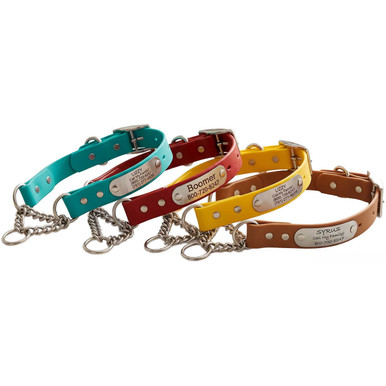
- Personalized Waterproof Chain Martingale NamePlate Collars combine a waterproof main strap, chain mechanism and engraved identification.
Explore the dogIDs martingale collar collection for current sizes, materials and personalization options.
Personalized Waterproof Chain Martingale NamePlate Collar
$39.00
Waterproof Chain Martingale Collar with Name Plate Finally, a martingale dog collar with a chain that’s also waterproof and personalized! It’s the best of both… read more
Frequently Asked Questions About Martingale Collars
Are martingale collars only for greyhounds?
No. They are popular for greyhounds and other narrow-headed dogs, but they can also be useful for supervised walking and training with other breeds and mixed-breed dogs. Individual fit and suitability matter more than the breed label.
Will a martingale stop my dog from pulling?
Not by itself. A martingale provides a leash connection and limited-slip fit. Loose-leash walking requires training, and persistent pulling may call for different equipment and professional help.
Can a martingale collar still put pressure on the neck?
Yes. Its tightening limit does not eliminate neck pressure or the possibility of injury. Correct fit, supervision and avoiding leash jerks or sustained tension are essential.
Can my dog wear a martingale all day?
Remove it when your dog is unattended, crated or playing where the collar could become caught. A martingale’s sliding loop creates an entanglement risk.
Should I use a nylon-loop or chain-loop martingale collar?
Both designs use a limited-slip mechanism, but they can feel and respond differently.
In our experience, a well-designed chain loop moves more freely through its rings than nylon webbing moves through metal hardware. We appreciate the smoother response as leash tension changes, including a prompt release when tension disappears.
Compare the weight and hardware of the specific collars you are considering, particularly for a small dog. The complete collar’s construction matters more than the loop material alone.
Nylon-loop martingales remain a good option for many dogs. Choose based on your dog’s comfort, proper fit, the mechanism’s movement and your handling preferences.
Why should I personalize a martingale collar used mainly for walking or training?
Identification matters even when your dog wears a martingale primarily for walks, outings or training sessions.
Unfamiliar surroundings, unexpected distractions and accidents can happen anywhere. If your dog becomes separated from you while still wearing the collar, readable contact information gives someone who finds your dog a way to reach you.
A personalized martingale combines that identification with the collar’s everyday function. Depending on the design, your contact information can be embroidered onto the strap or engraved onto a buckle or nameplate.
Check that the information remains readable and your phone number is current. Personalization does not change the collar’s supervision requirements or replace a microchip with up-to-date registration.
Is a martingale the same as a slip collar?
No. A martingale has a limited-slip mechanism that restricts how far it can tighten. A traditional slip collar does not have the same built-in travel limit. Both still require appropriate fit and handling.