
Dog Collar Size Chart: How to Measure Your Dog for a Collar
Table of Contents
- How to Measure Your Dog for a Collar
- Understanding Dog Collar Sizes
- Dog Collar Size Chart: A dogIDs Product Example
- Choosing a Collar Width
- Measuring for a Martingale Collar
- Check the Fit When the Collar Arrives
- Recheck Puppies, Coat Changes and Everyday Wear
- Need Help Choosing a Size?
- Frequently Asked Questions About Dog Collar Sizing
The right dog collar size starts with a measurement, not a breed name or a small, medium or large label. Measure your dog where the collar normally sits, allowing two fingers to slide comfortably under the measuring tape or string.
Then compare that measurement with the size options for the specific collar you want. Once the collar arrives, check the fit again: two fingers should easily slide under the fitted collar strap.
This guide explains how to measure, read a dog collar size chart and choose an appropriate width without adding unnecessary extra length.
How to Measure Your Dog for a Collar
Use a Flexible Measuring Tape
- Have your dog stand comfortably and calmly.
- Wrap a flexible sewing tape around the neck where the collar normally sits. Keep the tape flat and untwisted.
- Allow enough room for two fingers to slide comfortably between the tape and your dog’s neck. Do not pull the tape tight against the skin or leave it hanging loosely.
- Read and record the measurement in inches.
- Repeat the measurement to check your result before ordering.
Do not automatically add another one, two or three inches. The measuring method above already includes room for a comfortable fit. Follow any additional instructions on the particular product page rather than adding a second allowance.
No Measuring Tape? Use String and a Ruler
Use a piece of non-stretch string in place of the sewing tape. Wrap it around the normal collar position with room for two fingers underneath, mark where the ends meet, and measure that length against a ruler.
Keep your dog supervised while measuring and remove the string immediately afterward.
Understanding Dog Collar Sizes
A size label such as “medium” is only useful alongside the measurements for that product. Sizes can differ between brands and between collar styles from the same brand.
Look for either a neck-size range or a stated collar size with an explanation of how it is measured.
Adjustable Collars With a Neck-Size Range
A collar listed for a 13–18-inch neck can be adjusted within that range. If your measurement is 16 inches using the two-finger method, that range gives you room to adjust in either direction.
Where practical, choose a range that places your measurement comfortably inside it rather than at its limit.
Traditional Buckle Collars With Adjustment Holes
For applicable dogIDs buckle collars, the stated size is measured to the center adjustment hole unless the product page says otherwise. The holes on either side provide additional adjustment.
A stated 16-inch collar size is therefore different from the collar’s full end-to-end length. Check the product’s sizing instructions before comparing it with another collar.
For additional diagrams and measuring guidance, visit the dogIDs sizing guides.
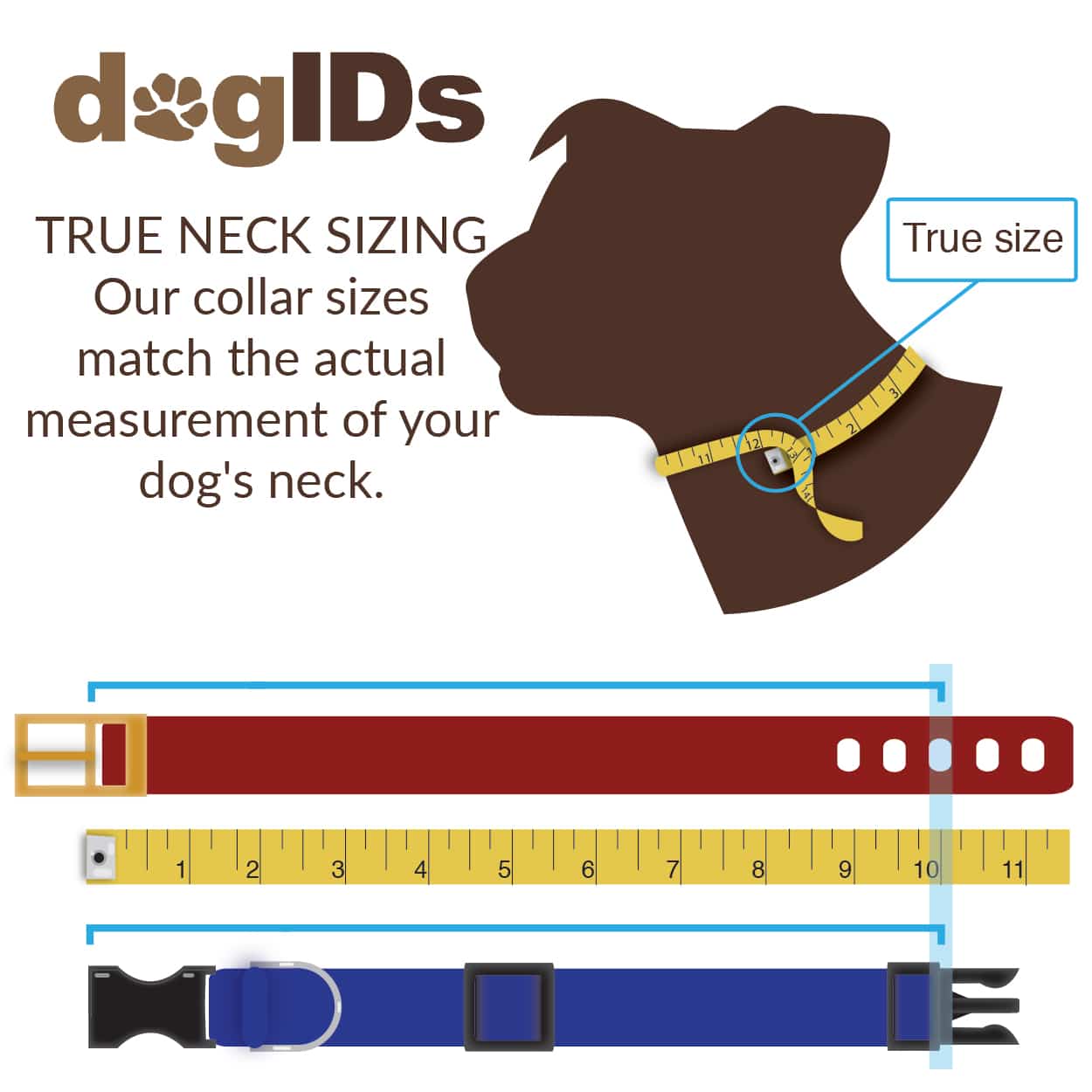
dogIDs uses true neck sizing. Measure with room for two fingers under the tape or string, then follow the selected collar’s sizing instructions. Do not add another blanket allowance.
Dog Collar Size Chart: A dogIDs Product Example
The chart below shows the listed neck-size ranges and strap widths for the Nylon Custom Engraved Buckle Collar. It is a product-specific example, not a universal chart for every dogIDs collar.
| Collar Strap Width | Listed Neck-Size Range |
|---|---|
| 5/8 inch | 8–10 inches |
| 5/8 inch | 10–12 inches |
| 5/8 inch | 11–13 inches |
| 3/4 inch | 9–12 inches |
| 3/4 inch | 11–14 inches |
| 3/4 inch | 13–18 inches |
| 1 inch | 13–18 inches |
| 1 inch | 16–23 inches |
| 1 inch | 20–27 inches |
For example, a 16-inch measurement falls within the listed 13–18-inch range in either a 3/4-inch or 1-inch strap width. Choosing between those widths also means considering your dog’s proportions, comfort and the weight of the hardware.
Always check the current product page before ordering. Other collar styles may offer different sizes, widths or measuring instructions.
Choosing a Collar Width
Collar width is the distance across the strap. Thickness describes the depth of the material. They are different measurements.
Choose a width and hardware combination that suits your dog’s proportions. A small dog may find bulky hardware uncomfortable, while a dog with a longer or larger neck may comfortably wear a wider strap.
Check that the collar does not crowd the jaw or interfere with comfortable head and neck movement. Avoid choosing by body weight or breed alone.
A wider collar does not replace loose-leash training or make persistent pulling harmless. If your dog regularly pulls against the collar, reassess the equipment and training approach.
Measuring for a Martingale Collar
A martingale needs attention to both its relaxed fit and its fit when the smaller loop reaches its tightening limit.
Follow the instructions for the particular design. A slip-on martingale also needs to pass over your dog’s head, so the widest head measurement matters as well as the neck measurement. A buckle-opening design may use different fitting steps.
The two-finger neck measurement is a starting point, not a substitute for checking the collar’s full adjustment and movement on your dog.
For detailed guidance on the mechanism and supervised use, read Martingale Collars: How They Work, Fit & Which to Choose.
Check the Fit When the Collar Arrives
Put the collar on according to its instructions and adjust it before attaching a leash.
- Check the space under the strap: Two fingers should easily slide between the collar strap and your dog’s neck.
- Check the position: The collar should sit comfortably without crowding the jaw or hanging excessively loose.
- Check movement: Watch your dog turn their head, walk and lower their head. Reassess if the collar rubs or appears uncomfortable.
- Check security: Make sure the buckle is fully fastened and the strap is correctly threaded through its hardware.
- Check the design: For a martingale, check both relaxed and tightened positions and confirm that the mechanism moves freely.
The two-finger check helps assess fit, but it does not guarantee that a dog cannot escape. A dog’s head shape, the collar design, adjustment and behavior also matter.
If you cannot achieve a comfortable, appropriately secure fit, contact us before using the collar on a walk.
Recheck Puppies, Coat Changes and Everyday Wear
A collar that fits today may need adjusting later. Check frequently on growing puppies and whenever your dog’s weight or coat changes.
For dogs with longer coats, check the fit before and after grooming. Avoid measuring over tangled or heavily matted fur.
Inspect the strap, stitching, buckle, adjustment hardware and ID attachment regularly. Follow the care instructions for the material and replace damaged equipment.
Do not leave a collar oversized to provide growing room. Choose an adjustable size that fits now, and continue checking as your puppy grows.
Need Help Choosing a Size?
Have your dog’s measurement and the name of the collar you are considering ready when you contact us. Our team can help you interpret that product’s sizing options.
Email service@dogids.com, visit our sizing guides, or view our dogIDs collar-measuring video.
Still deciding on a style? Read How to Choose the Right Dog Collar for Your Dog or explore our personalized dog collars.
Frequently Asked Questions About Dog Collar Sizing
Should I add inches to my dog’s neck measurement?
Not automatically. When using the dogIDs method described here, measure with room for two fingers under the tape or string, then compare that result with the specific collar’s sizing instructions. Do not add another blanket allowance.
What size collar should I buy for a 16-inch measurement?
For a dogIDs collar sized by neck measurement, look for a stated 16-inch size or an adjustment range comfortably containing 16 inches, unless the product page specifies a different method. Check the fitted collar after it arrives.
Can I choose a collar size based on breed?
Breed can offer a rough starting point when browsing, but it does not replace measuring. Dogs of the same breed can have different neck sizes and proportions.
Can I measure my dog’s old collar?
Yes, if it still fits correctly and you follow the measuring method for the new collar. Do not assume the old collar’s full end-to-end length is its stated size. For applicable traditional buckle collars, measure from the buckle reference point specified by the manufacturer to the adjustment hole being used.
What if my dog is between sizes?
Compare the actual adjustment ranges and choose one that can fit your dog correctly now, preferably with room to adjust in either direction. For a collar sold by a center-hole size, check the available hole range or ask our team for help rather than automatically sizing up or down.
How much space should there be under a fitted collar?
Two fingers should easily slide under the collar strap. Also check the collar’s position, security and any design-specific instructions. Finger clearance alone does not establish that every collar is correctly fitted.