

How To Choose the Right Dog Collar (2026 dogIDs Pack Leader’s Guide)

If you're new to the dog world, choosing a collar can feel like trying to order coffee in a new language. Martingale? ScruffTag? Biothane?
I’ve seen thousands of collars leave our shop over the last 20+ years. I’ve seen what lasts, what fails, and what keeps dogs Known and Safely Home. The "best" collar isn't the most expensive one—it's the one that matches your dog's specific lifestyle.
Here is my no-nonsense guide to finding the perfect durable gear for your new family member.
Rule #1: Identification Comes First
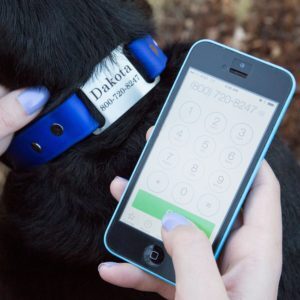
Before we talk about fashion or materials, we have to talk about safety. A collar’s #1 job is to speak for your dog when you aren't there. Afterall, dogs can’t talk, so I think we can all agree on how important this is.
Standard ID tags are fine, but they jingle, can fade over time, fall off and can get caught in heat vents, between deck boards, in crate wires, etc. That’s why I always recommend custom dog ID collars where the information is built right in.
- The ScruffTag® Advantage: This is our signature design where the nameplate sits on the back of the neck (the scruff). It’s silent, easy to read without reaching under the dog's chin, and guaranteed for life. If you have a lot of custom text you want on your dog at all times, this is usually the best option due to it’s large surface area.
- Rivet-On NamePlate: This is a tried and true solid option to make sure your contact information stays on your dog silently with no risk of getting caught on obstacles. It’s a very classy look once riveted onto a collar strap. Hence many people prefer this. Traditional, silent and dependable.
- Embroidery: Great for high visibility. At dogIDs we stitch your contact phone number directly into the nylon webbing so it can be read from a distance. Another safe and silent option but accommodates less text characters.
- Laser Engraving: We use high-power industrial fiber lasers to etch your info deeply into the buckle or nameplate. Unlike cheap tags that rub smooth in a year, ours are legible forever.
Step 2: Match the Material to the Activity
Just like you wouldn't wear a tuxedo to swim laps, you shouldn't put a leather collar on a lake dog. Leather cleaners and conditioners help repel water and prevent cracking, etc, but if your dog is in and out of water often, there’s no way around it, leather will break down.
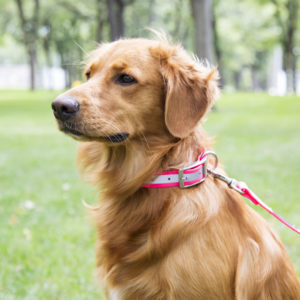
For the Water Dog & Mud Lover
Winner: Waterproof Soft Grip (Biothane)
If your dog thinks every puddle is a swimming pool (like my Lab, River, always did), you need this material. I’ve been making dog collars with this material since the mid 90’s and still haven’t found anything better.
- Why: It looks and feels like leather but is made from a high-tech Biothane material that is completely waterproof and odor-proof. And though it’s super tough, it has a soft texture and stays very flexible in all temperatures.
- Maintenance: Wipe it with a damp cloth. Done. No "wet dog" smell, ever.
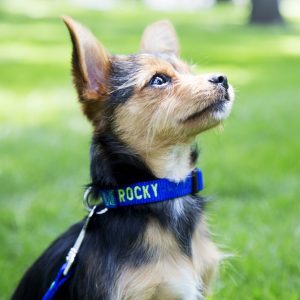
For the Comfort Seeker & Puppy
Winner: Nylon
Nylon is the "T-shirt and Jeans" of the dog world. It’s soft, lightweight, and comes in virtually every color.
- Why: It’s lightweight, soft and gentle on sensitive necks.
- Best For: Everyday wear, growing puppies, and dogs who sleep in their collars.
For the "Classy Canine"
Winner: English Bridle Leather
There is nothing quite like the look of a well-worn Leather Dog Collar. At dogIDs we use premium English Bridle leather that breaks in beautifully over time, just like a good baseball mitt. It’s extremely durable but takes a while to break in. As it absorbs your dog’s natural oils, it looks so nice and becomes buttery soft.
- Best For: City walks, dry environments, and dogs who prefer a dignified sense of style.
Step 3: Choose Your Buckle Style
- Traditional Buckle: Works like a belt. Secure and classic. Great for dogs who wear their collar 24/7.
- Quick Release: The standard "click" buckle. Easy to take on and off, making it perfect for dogs who go to daycare (where quick removal is often required). Just squeeze the side release latch to release.
- Martingale (The "No-Slip" Solution): If your dog has a neck wider than their head (like a Greyhound or Bulldog) or is an escape artist who backs out of collars, get a Martingale Collar. It tightens gently when they pull, preventing escape without the choking effect of a chain. Note: Because these fit looser when not pulled, they are best for walking and training, rather than all-day wear inside the house.
Final Sizing Tip: The Two-Finger Rule
A personalized collar is only safe if it fits. When you measure your dog's neck, you should be able to comfortably slide two fingers between the tape measure and their neck. I always recommend using a sewing tape or string for accurate measurements. Make sure to measure the area where you want the collar to sit as a dog’s neck varies considerably depending on the position.
Pro Tip: If your dog is between sizes, always size up. You can always tighten a larger collar, but you can't stretch a small one! Also, if your dog’s weight fluctuates at different times of the year, keep that in mind.
You’ve got the knowledge, now let’s get the gear. Shop our collection of Personalized Dog ID Collars here and let's keep your best friend Known and Safely Home.
Explore Popular Articles
-
BioThane vs. Leather: Which Material Wins for Your Dog?
Mar 12, 2026Every dog owner eventually faces the Great Collar Debate. Do you go with the classic, time-honored l
-

How To Choose the Right Dog Collar (2026 dogIDs Pack Leader’s Guide)
Dec 10, 2025If you're new to the dog world, choosing a collar can feel like trying to order coffee in a new lang
-
Why We Ditched Seed Oils: The Story Behind Our New Dog Treats
Dec 03, 2025We all know that feeling. You’re standing in the pet aisle, holding a bag of dog treats, squinting a